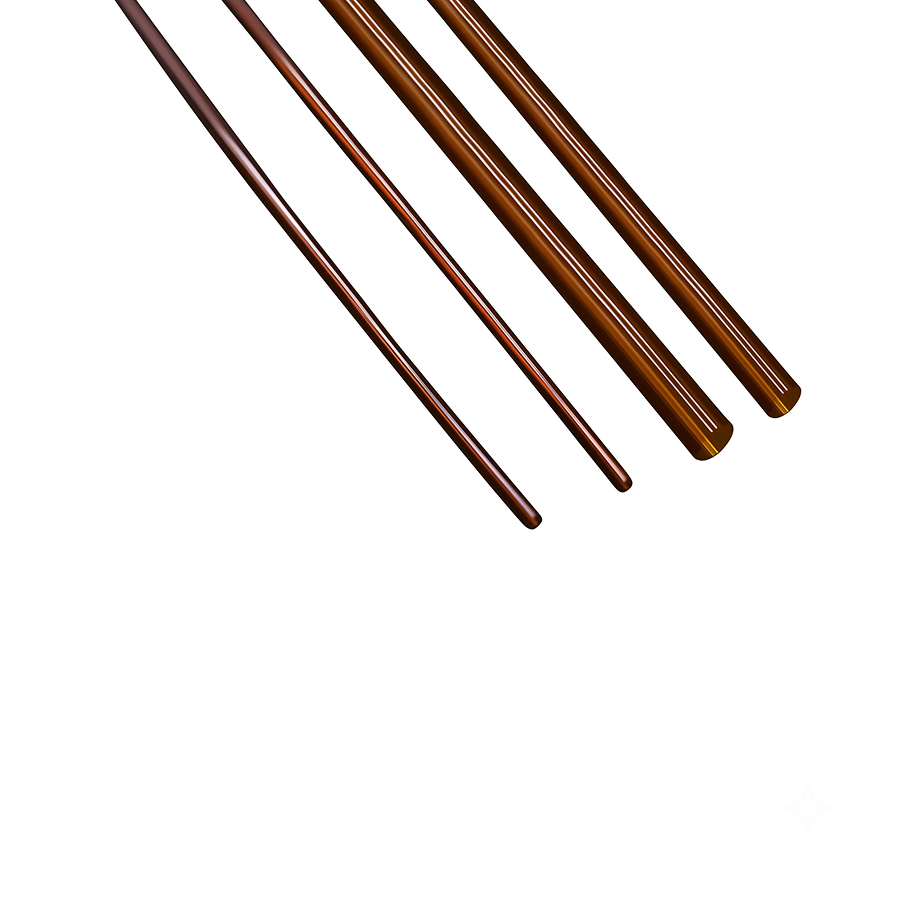
Where the two materials part ways
PA (polyamide) is a nylon-family thermoplastic. It can be melted and extruded, then reheated to bond to other tubes or merged into layers by reflow. Catheters mostly use the low-moisture grades PA12 and PA11, and PEBAX, a polyamide elastomer, belongs to the same family.
PI (polyimide) is a polymer that does not melt. Instead of melt extrusion, a precursor solution is coated onto a mandrel in repeated passes and cured into a tube. This lets thin-wall tubing around 0.02 mm be made uniformly, and once cured it holds its shape even at high temperature.
When to choose PA
- Sections such as the distal end where flexibility and kink resistance come first
- Shafts bonded from segments of different hardness — PEBAX 25D to 72D
- Balloons and shafts of balloon catheters
- High-volume single-use catheters where cost matters
PA changes slightly in size and stiffness as it absorbs moisture. For parts with tight tolerances, use low-absorption PA12 and state the conditioning before measurement on the drawing.
When to choose PI
- Microcatheters where the outer diameter is fixed but the lumen must be as large as possible
- Shafts that must transmit push and torque through a thin wall
- Inner layers that must survive outer-layer reflow and other heat processes
- Precision parts that need an ID tolerance of about ±0.01 mm
Because PI is stiff, a sharp bend can kink it. Sections with tight bends are handled with braid- or coil-reinforced PI tubing, and the distal tip is usually joined in a soft material such as PEBAX.
Using both in one catheter
Real catheters often use both, split by section, rather than picking one. The proximal section gets push from PI or reinforced PI tubing, and PEBAX hardness steps down toward the distal end for flexibility. A typical three-layer build is a PTFE liner, a stainless-steel braid and a PEBAX or PA jacket.
What to settle before a spec inquiry
- 01Target OD, ID, wall and allowed tolerances
- 02Process temperatures — reflow, thermal bonding, sterilization method
- 03Performance needed per section — push, torque, flexibility
- 04Joining method and materials of adjacent parts
- 05Expected volume and sample schedule
Octudex supplies PA and PEBAX extruded tubing as well as PI and PI braided tubing. Send a drawing or target dimensions and we will tell you first which material fits.