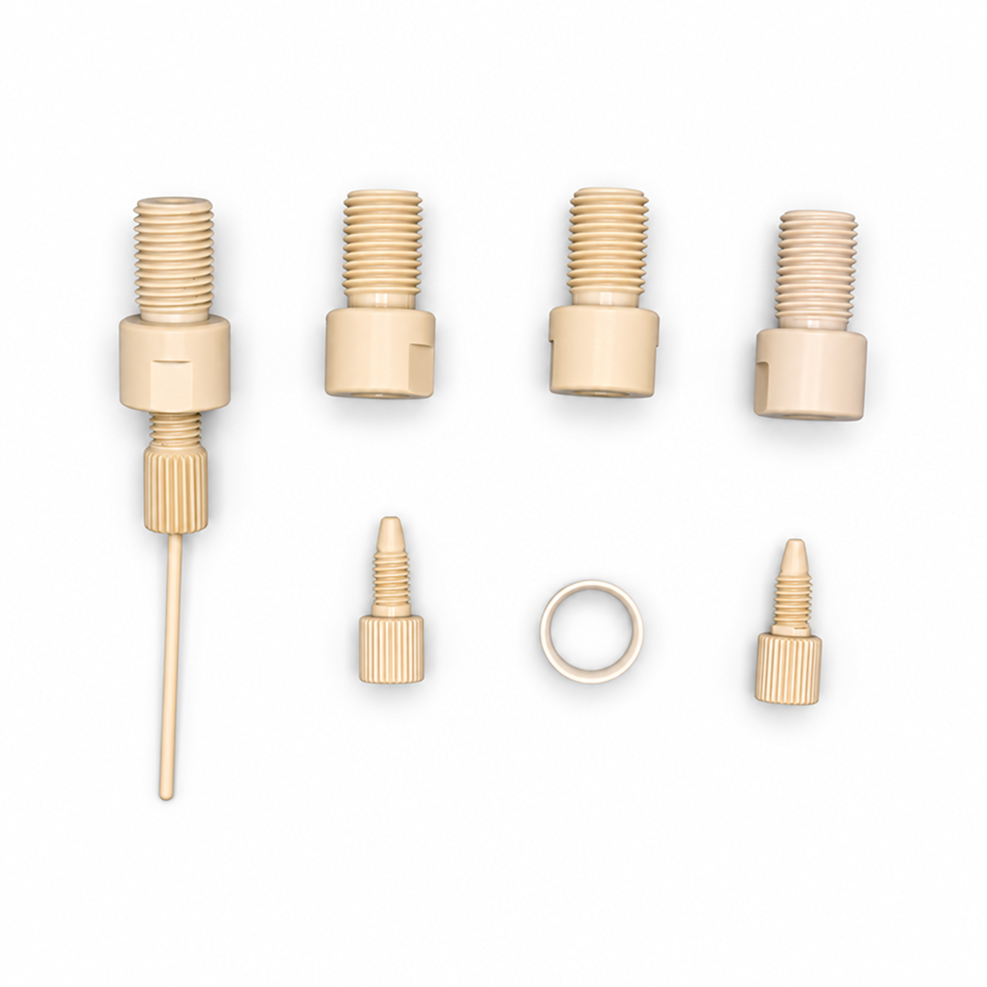
Start with medical-grade stock
Settle the material grade before machining. Medical device parts use medical-grade rod or plate with an ISO 10993 and USP Class VI test history, and the material lot number is carried through to the machining record. Long-term implants need implant-grade material and the supplier's regulatory documentation.
Carbon- or glass-fiber-reinforced PEEK is stiffer but wears tools quickly. When machining reinforced grades, plan on PCD tooling from the start.
Cutting parameters
Heat buildup smears the PEEK surface and makes dimensions drift. Rather than pushing cutting speed, remove heat first with sharp edges and steady cooling. Oil-based coolants leave residues that are hard to clean, so they are usually avoided for medical parts.
Stress relief and dimensional stability
Residual stress in rod stock shows up as warping or dimensional change after machining. For tight-tolerance parts, rough-machine, anneal (stress-relief heat treatment), then finish-machine. PEEK expands more with heat than metals, so fix the inspection temperature before measuring.
Tolerances tighter than ±0.05 mm are possible but depend on geometry, thickness and measurement method. Marking critical dimensions separately from general tolerances on the drawing improves both the quote and the yield.
Burrs, surface and cleaning
On a medical part, a burr is a foreign particle. State the deburring method, acceptance criteria and surface roughness (Ra) on the drawing. After machining, parts are cleaned to remove cutting residue and particles, then inspected and packed in an ISO 7 or better cleanroom.
Traceability and sterilization
A batch record that runs from material lot through machining, cleaning, inspection and packing lets you narrow the scope if a problem appears. PEEK withstands autoclave, gamma and EtO sterilization, but the final method is best fixed early in design.
Machining or molding — when to switch
For design verification and small runs, machining is faster because no mold is needed. Once the geometry is fixed and volumes grow, injection molding wins on part cost. Both can use the same material grade, so a common path is to verify with machined prototypes and then move to molding.
Octudex supplies machined and molded PEEK parts as well as PEEK tubing. Send a drawing and we will confirm first whether the process and tolerances fit.