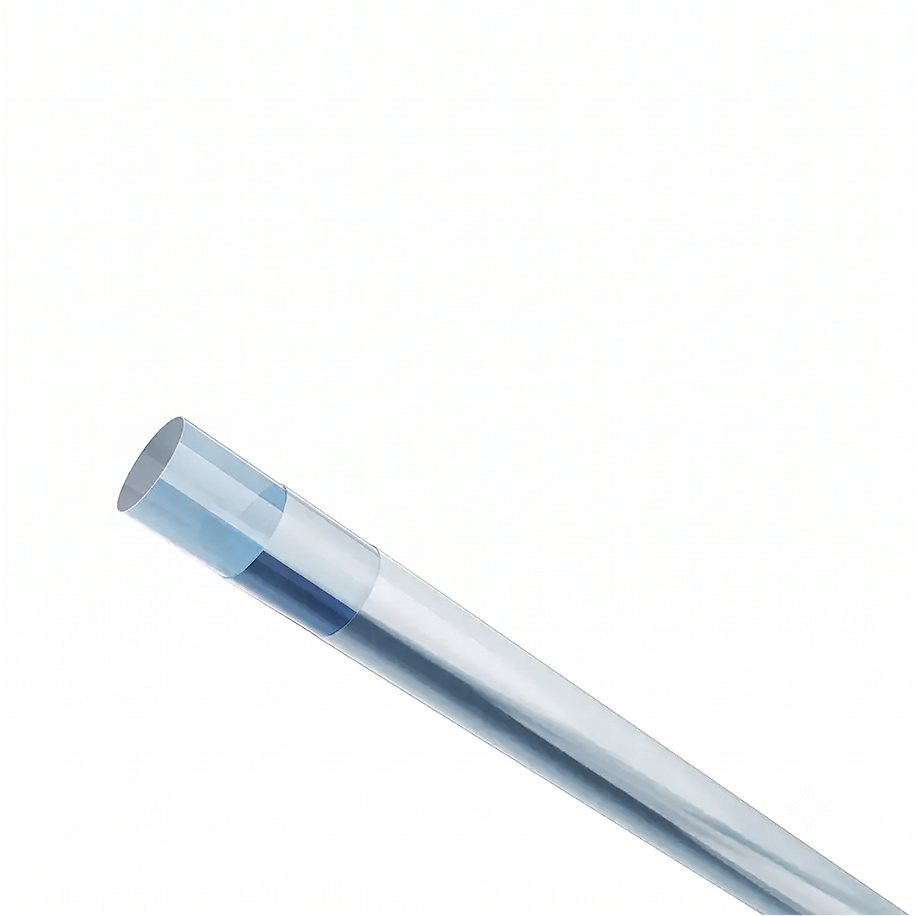
Multi-layer tubing is built from two or more material layers. Each layer is chosen against criteria such as strength, flexibility, chemical resistance and impermeability — the inner layer carries biocompatibility, the outer layer strength or protection.
| Double-layer tubing | Triple-layer tubing | |
|---|---|---|
| Outer diameter | From 0.3 mm | 0.20 mm – 1.50 mm |
| Tolerance | ± 0.0127 mm – 0.1 mm | ± 0.0127 mm – 0.0254 mm |
| Wall | From 0.05 mm | 0.05 mm – 0.35 mm |
| Length | Maximum 1500 mm | Maximum 2000 mm (varies with dimensions) |
| Outer jacket | PU · Pebax · Nylon · PP | PEBAX · PA · TPU |
| Inner / middle layer | PU · Pebax · Nylon · PP · HDPE | PE |
Medical device tubing — catheters, infusion lines and drainage systems, more durable and more flexible than single-layer tubing. Drug delivery — IV lines, feeding tubes and dialysis tubing, where the multi-layer build controls flow rate and prevents leakage.
Inner (low friction · chemical resistance), tie and outer (stiffness · printability) layers are combined for the application. Tell us the properties and we propose the material stack.
Yes. Each layer thickness and total wall are taken as spec.
Yes. TDS · MSDS come with every specification reply. ISO 10993 biocompatibility data varies by grade and lot, so we confirm it with the factory (Linstant) and reply.
Standard sizes start with small sample lots. MOQ and lead time depend on dimensions, material and secondary processing — send OD · ID · wall · tolerance · length · quantity and we reply within one business day.
Inner diameter, wall thickness, length and operating environment — those four settle the item. We reply with TDS, MSDS and MOQ.